by Navadeep Varma | Feb 3, 2026 | Blog
Today, content is being produced and consumed at a rapid pace. The digital landscape is brimming with all types of content; some authentic and verified, while others not even close to reality. In a landscape of fragmented content, to build brand authority isn’t just a perk—it’s a necessity. When the market is crowded, trust is the only bridge that successfully connects a business to its customers. In simpler words, here is what that means: How do you get people to trust you when everyone is overwhelmed with information and nobody believes what they see online anymore?
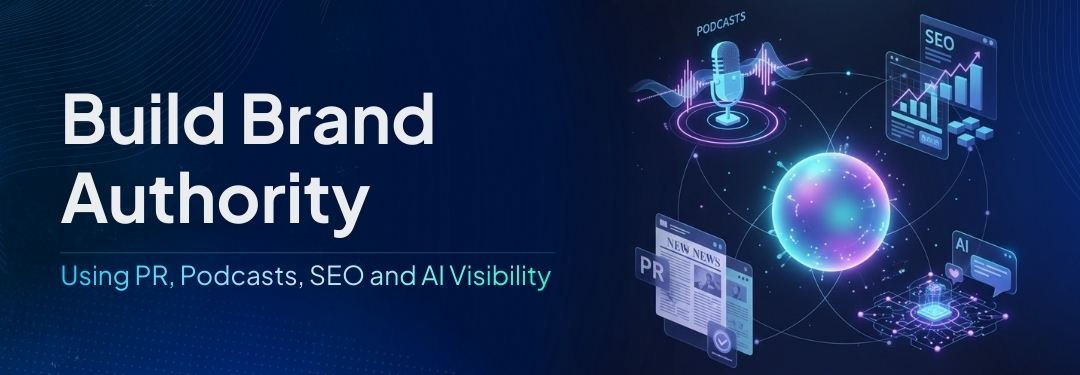
The solution is the “New Trust Stack.” It is a modern game plan that builds your reputation by combining four specific tools:
- PR: Getting respected news outlets to talk about you.
- Podcasts: Letting people hear your voice and personality.
- SEO: Making sure you show up first when people search for answers.
- AI Visibility: Ensuring AI tools (like ChatGPT) mention you as a reliable source.
Gone are the days when a glossy ad campaign or a well-placed article alone could guarantee credibility. Modern consumers are smarter, wiser, and more likely to trust diverse, consistent touchpoints across multiple platforms. In the next section, let’s explore how marketers prioritize and implement use of PR, Podcasts, SEO and AI visibility.
Adopting PR, Podcasts, SEO and AI Visibility to Build Brand Authority
1. Press Releases: The Engine of Brand Authority
At its core, the strategic press release remains a crucial tool to build brand authority by transforming company updates into newsworthy milestones. When your brand’s achievements are picked up by reputable news wires and trade publications, it provides a layer of institutional “proof” that marketing alone cannot buy. This isn’t just about announcing a new hire or a product launch; it’s about crafting a narrative of momentum and industry leadership.
A well-distributed press release builds brand authority by creating a permanent, searchable record of your company’s growth and expertise. Unlike social media posts that disappear in a feed, a press release indexed by major search engines acts as a credible anchor for your digital footprint. For a more effective distribution strategy, think beyond the standard “announcement” and consider data-driven reports, community impact initiatives, and pioneering research findings. This ensures that when stakeholders perform due diligence on your brand, they encounter a history of professional excellence validated by independent journalistic standards.
2. Podcasts: The Intimate Connection
While PR provides broad validation, podcasts seek to establish an intimate and direct bond with your audience. In an audio-first world, these long-form, niche-specific talks help to build brand authority and trust amongst listeners. Whether you host your own podcast, appear as a guest on industry-relevant shows, or sponsor popular programs, the medium fosters a unique level of trust.
Unlike fleeting social media posts, podcast listeners often dedicate significant time to an episode, absorbing information while commuting, exercising, or performing household tasks. When you share insights, tell stories, and engage in authentic conversations, you position yourself as a humanized, approachable authority. Furthermore, podcast content is evergreen; a well-produced episode can continue to attract new listeners and build trust for months or even years. It’s also a powerful tool for repurposing content, generating snippets for social media, and transcribing for SEO benefits.
3. Search Engine Optimization (SEO): The Pathway to Discovery
No matter how credible your PR or how engaging your podcast, if people can’t find you, your efforts are diminished. This is where SEO steps in as the crucial pathway to discovery and ongoing trust-building. SEO ensures that when potential customers search for solutions, information, or even reviews related to your industry, your brand appears prominently.
Modern SEO is far more sophisticated than keyword stuffing. It’s about providing genuine value, demonstrating expertise, experience, authoritativeness, and trustworthiness (E-E-A-T) – concepts that Google heavily prioritizes. This means you naturally build brand authority by creating high-quality, relevant content that answers user questions, optimizing your website for user experience, ensuring mobile responsiveness, and building a robust backlink profile from reputable sources. Effective SEO ensures that when curiosity strikes, your brand is the reliable answer, reinforcing the trust cultivated through PR and podcasts.
4. AI Visibility: The Future of Trust and Discovery
The newest and rapidly evolving layer of the Trust Stack is AI Visibility. As AI-powered tools like ChatGPT, Bard, and other large language models (LLMs) become primary sources of information for consumers, brands need to adapt. How will your brand be represented when an AI is asked about your industry, your products, or your solutions?
AI models learn from the vast ocean of data available online. This means that strong PR, comprehensive SEO, and rich, expert-driven podcast content are now critical inputs for shaping how AI “understands” and articulates your brand’s value. If your brand consistently appears in credible news sources, is discussed by authorities in podcasts, and ranks highly for relevant search queries, AI is more likely to retrieve and synthesize positive, accurate information about you.
To build brand authority for AI visibility, you need to ensure your content is clear, factual, well-structured, and provides definitive answers to common questions. It’s about being present and authoritative across all digital touchpoints so that when an AI summarizes information, your brand is presented as a trusted, knowledgeable entity. This isn’t just about being found on Google, it’s more about being recognized and recommended by the intelligent agents that are increasingly guiding human decisions.
Use Kleza Solution’s Vast Expertise to Build Brand Authority
Reading this blog and understanding the layers of the Trust Stack is not enough to help you build brand authority. The truth is that your brand needs the help of experts who consistently help brands across various niches and domains build content that is reliable, trusted and authoritative.
At Kleza Solutions, we have an experienced digital marketing team who know in-depth SEO skills and have also adopted essentials of PR, podcasts and AI visibility. They can help you on the path to build brand authority with their knowledge and expertise. We also offer various services such as Website Development, E-Commerce and Digital Marketing Services that are integrated with the latest AI tools to help enhance your brand’s credibility, amplify your message, and drive sustainable growth. Our team consistently works with you to innovate, strategize and create powerful content that has all the essential layers of the Trust Stack to build brand authority and drive trust for your brand.
Contact us today to transform your digital presence into a powerhouse of trust and authority. Let’s build your future, together.
by Navadeep Varma | Feb 3, 2026 | Blog
In the world of SEO, unpredictability is the only constant! The industry has moved quickly from stuffing keywords to chasing backlinks, with each phase confidently labelled as “best practice.” Now, just when marketers thought that they had the algorithm figured out, large language models (LLMs) came into play.
Remember typing “best cafés near me” and getting a neat little list to scroll through? Today, you ask the same thing and an LLM like Gemini, Perplexity, or ChatGPT hands you a curated answer with images, reviews, menus, and vibes, basically doing your local research for you. LLMs are transforming localized SEO. It’s not enough to rank anymore. If your digital presence isn’t credible and deeply local, the AI might bypass you entirely. Since LLM responses now sit at the very top of the search results (replacing traditional organic listing), your strategy has to evolve. It’s as simple and as complicated as that. In this blog we have included some best practices for localized SEO for LLMs so that you won’t just be in the search results—you’ll be the answer!
The Stats That Show Localized SEO for LLMs Has Changed
It’s easy to say that LLMs are changing local search. But, the impact becomes undeniable when the numbers are examined. Data now shows a clear shift in how people evaluate and choose local businesses.
These stats show why localized SEO for LLMs is a must if you want your business to be seen, trusted, and chosen:
- The global LLM market is projected to reach $82.1 billion by 2033, signaling that AI is becoming central to business and search technology.
- AI summaries appear in around 50% of Google searches today, and that figure is projected to rise to 75% by 2028.
- Around 60–63% of all searches end without a click, because users get what they need right in the AI-powered answer box.
- Organic traffic isn’t gone, it’s shifting — traditional SEO alone drives less traffic than before. Sites that aren’t part of AI summaries may see significant drops in visibility.
Best practices for Localized SEO for LLMs
Getting noticed by AI isn’t just about keywords anymore. LLMs look for businesses that show real, local expertise and make it easy to find accurate information. The following strategies can help your business stand out and become the go-to answer in your area:
1. Build Content Around Localized Experience
LLMs prioritize “real-world” signals. Instead of just stating facts, provide content that proves you operate in a specific physical area. Use specific landmarks, local jargon, and neighborhood-specific advice.
- Example: If you are a plumber in Austin, don’t just write “We fix pipes in Austin.” Write a guide on “How Austin’s hard water affects pipes in the Travis Heights neighborhood” and mention local water treatment standards.
- Why it works: It provides “unique data points” that the LLM can use to distinguish you from generic national competitors.
2. Use Clear Headings and FAQs
LLMs are “pattern hunters.” They scan your page for direct answers to user prompts. Structured headings (H2, H3) and FAQ sections act as a map, making it easy for the AI to “clip” your answer and credit you as the source.
- Example: Instead of a heading like “Our Rates,” use “How much does a window cleaning service cost in Seattle?” Follow it with a 2–3 sentence direct answer.
- Why it works: This matches the conversational way people ask AI questions (e.g., “Hey Gemini, how much for a window cleaner in Seattle?”).
3. Maintain Consistency Across Platforms
LLMs don’t just look at your website; they “read” the whole internet. Your NAP (Name, Address, Phone Number) must be identical on your website, Google Business Profile, Yelp, Apple Maps, and social media.
- Example: If your address is “123 Main St., Suite 4,” don’t write it as “123 Main Street #4” on Facebook. Keep the format exactly the same everywhere.
- Why it works: Consistency creates a “strong entity.” If the AI sees the same info 10 times, it treats it as a “fact.” If it sees conflicting info, it may ignore you to avoid giving the user a wrong address.
4. Internal Linking
Think of internal links as “vouching” for your own pages. In localized SEO, you should link your general service pages to your specific location pages and vice versa.
- Example: On your “Home Security Systems” page, include a link that says: “See our specific security recommendations for Downtown Miami residents.”
- Why it works: It helps the LLM understand the relationship between your services and your geography. It builds a “cluster” of authority that tells the AI you are the go-to expert for that topic in that area.
Wrapping it Up!
The world of search has moved from “finding a link” to “getting an answer.” For local businesses, this means your online presence needs to feel more human and hyper-local than ever before. By focusing on real-world experiences, keeping your details consistent, and answering questions directly, you aren’t just crossing your fingers for a high rank—you’re proving to AI models that you are the most reliable expert in your neighborhood.
Kleza solutions can help you navigate this shift. We take the guesswork out of this new AI-driven landscape by helping you build a digital footprint that LLMs actually trust. From optimizing your local data to creating content that positions you as a true local expert, we make sure your business is the one AI recommends. If you’re ready to stop chasing algorithms and start being the answer, let’s talk about getting your local SEO ready for the future. Call us at +1 913-800-2728 and let us assist you.
by Navadeep Varma | Dec 12, 2025 | Blog
Digital marketing is one of the fastest-evolving markets, expected to hit $1.8 trillion by 2033. This is why keeping up with digital marketing trends in 2026 is crucial for brands focused on growth. The shift happening now is bigger, faster, and a lot more exciting. People want brands to understand them, not just target them. And with technology becoming smarter and more intuitive, the pressure is on digital marketers to create work that actually connects.
This is the year AI becomes less of a buzzword and more of a practical everyday tool. It’s also the year brands stop playing safe. We’ll see more creativity, more experimentation, and more experiences that blend the online world with real life. In this blog, we’re breaking down the top digital marketing trends in 2026—the shifts that will shape how you create, communicate, and stay ahead in a world that moves fast.
5 Key Digital Marketing Trends in 2026
Digital marketing trends in 2026 are all about blending technology with human connection. Audiences are smarter and expect brands to understand them without being intrusive. The game is no longer just about visibility — it’s about creating experiences that feel personal and effortless.
Let’s take a closer look at the 5 key digital marketing trends in 2026 that are shaping how brands interact with their audiences.
1. Make Content AI-Ready and Human-Friendly
Think about asking a question and getting the exact answer in seconds — no ads, no endless scrolling. That’s how AI search works now. Tools like ChatGPT, Gemini, and Perplexity are where people go first. AI also learns what users like and recommends things before they even search. Your content must be easy for AI to read and simple for humans to enjoy.
2026 SEO Focus:
- Create content that AI can easily read, understand, and summarize.
- Use clear structures like FAQs, lists, and short how-tos.
- Keep sections brief, factual, and effortless to scan.
- Blend AI-generated insights with human tone, context, and clarity.
2. Design Smooth, Mobile-First Experiences
People are less patient than ever. Mobile dominates traffic, and zero-click searches are growing, meaning users might see your content but never click through. Your website experience has to feel smooth, fast, and effortless to keep people engaged and coming back.
2026 SEO Focus:
- Prioritize fast-loading mobile pages and tap-friendly buttons.
- Keep layouts clean and navigation intuitive.
- Format content so AI snippets can easily pick it up.
- Build direct traffic through email, social, and branded search.
3. Build Pages Users and Google Love
Google no longer rewards content that exists just to fill space. Pages that genuinely help users, load quickly, and provide accurate info are the ones that get noticed. Low-value AI content is being filtered out, so creating real value is essential.
2026 SEO Focus:
- Focus on helpful, factually accurate, and user-focused content.
- Ensure pages load quickly and interact smoothly.
- Include local intent signals and first-party data insights.
- Align content with actual user search intent.
4. Make Ads Work Harder for You
Ads aren’t random anymore. AI handles bidding, audience targeting, creative testing, and placement. This makes campaigns more efficient and effective, but rising costs mean every ad dollar must count. Smart targeting and creative strategy are essential.
2026 SEO Focus:
- Use AI to predict audiences, optimize creatives, and automate bidding.
- Leverage first-party data to improve ad relevance.
- Focus on visuals, post-click experience, and seamless user flow.
- Let AI handle repetitive tasks, but guide strategy yourself.
5. Strengthen Your Brand and Strategy
With third-party cookies gone, brands can’t rely on guesswork. First-party data, predictive analytics, and strong branding are now essential. Users remember brands they trust, and those brands will dominate visibility, conversions, and loyalty in 2026.
2026 SEO Focus:
- Collect first-party data: email lists, CRM, website behavior.
- Use predictive analytics to plan campaigns and forecast ROI.
- Build a memorable, trustworthy brand that sticks.
- Blend AI insights with human strategy for meaningful connections.
As the New Year is upon us, it’s the perfect time to prepare for the shifts that will define digital marketing trends in 2026. Audiences are more conscious, platforms are more intuitive, and the line between online and offline experiences keeps fading. For marketers, this means one thing: evolve or get left behind. The brands that thrive in 2026 won’t be the loudest — they’ll be the ones that listen and create value in ways that feel truly personal.
If all this sounds exciting but a little overwhelming, you’re not alone — and that’s where Kleza Solutions comes in. We take a thoughtful approach to digital marketing, helping you focus on what truly matters for your brand. Think of us as an extra set of hands (and brains!) keeping your marketing smart, simple, and future-ready, without adding any pressure. You run your business; we’ll make sure digital marketing trends in 2026 work in your favor. Call us today at +1 913-800-272, and let’s explore how we can help your brand thrive in 2026.

by Navadeep Varma | Nov 25, 2025 | Blog
Holidays are one of the best times of the year — a season where businesses aim to boost sales and users look for the best deals, quick answers, and smooth experiences. But what if, right at the moment they need you most, your website slows down with glitches, or confuses them? What will the right holiday website maintenance checklist to follow?
During the holiday season, people often juggle with gift lists, travel plans, and last-minute decisions. They open your website hoping to find quick answers — but a slow page, a broken link, or a confusing layout is enough for them to close the tab and never return.
Not because your service isn’t good, but because the experience felt stressful at a time when they already have too much on their plate.
That’s why the holidays aren’t just about traffic — they’re about trust. So before the festive rush kicks in, here’s a simple holiday website maintenance checklist to help you stay prepared and keep every visitor happy.
Quick Holiday Website Maintenance Checklist to Follow
Run a Quick Website Audit
Before the holiday rush begins, one of the smartest steps you can take is running a quick website audit. This helps you catch issues early—like slow-loading pages, mobile incompatibility, broken links, or any hidden errors that could interrupt a visitor’s experience.
Since technologies (like website frameworks) and search algorithms (like Google’s) keep evolving every year, auditing your site especially during the holiday seasons ensures you’re not falling behind. Skipping this step may lead to bigger problems and missed opportunities during the busiest time of the year.
Optimize Mobile Performance:
Most shoppers prefer browsing and buying through their mobile phones because it’s quick, convenient, and always within reach. To make the most of this traffic, ensure your website is fully optimized for mobile use. Check whether your pages load smoothly, buttons are easy to tap, menus are simple to navigate, and important actions like payments, comparisons, and location access work without friction. A seamless mobile experience doesn’t just look good—it directly boosts user satisfaction and can significantly increase your holiday sales.
Declutter and Refresh Your Website
During the holiday rush, users have far less patience than usual—they don’t want to wait, search, or struggle to find what they need. This is the moment to understand your users and keep everything they care about right at their fingertips.
Give your website a fresh, clean look that’s easy to understand. Inspect each page and remove outdated information, unnecessary images or videos, and anything that slows down the experience.
Optimizing key landing pages can make navigation smoother, reduce bounce rates, and help users reach their destination faster.
Optimize your CTAs
Your Calls-to-Action (CTAs) are some of the most important elements of your holiday website maintenance checklist. The clearer and more visible they are, the easier it is for users to take the next step—whether it’s making a purchase, booking an appointment, or simply learning more.
Use action-driven CTAs like “Schedule an Appointment,” “Sign Up,” “Contact Us,” “Add to Cart,” or “Subscribe.”
Ensure they stand out through strong colors, clean design, and strategic placement so users never miss them.
Adding holiday-themed illustrations or subtle festive elements can also make your website feel more inviting and engaging—helping you connect with users during the busiest season of the year.
Unify Your Holiday Message Everywhere
During the holidays, shoppers move fast — and mixed messages can confuse them just as quickly. Make sure your website, ads, emails, and social posts all speak the same holiday language.
Keep your landing pages aligned with the look and message of your holiday campaigns. A simple, clean seasonal design helps users recognize your brand instantly and feel confident that they’re in the right place. When everything looks connected, customers don’t have to think twice — they browse freely, trust more, and convert faster.
Make Sure Your Website Can Handle Holiday Traffic
What many businesses overlook is that more traffic needs more server power. The hosting plan that works fine in July may not survive the surge in November and December.
This is where scalable hosting becomes your best friend. Many hosting providers can automatically boost your server capacity whenever traffic spikes, keeping your site fast and stable. You only pay extra during those high-traffic moments — not the whole year.
If you expect more shoppers this holiday season, upgrading to scalable hosting is one of the smartest ways to stay ahead and protect your sales.
Optimize the Checkout Process
A streamlined checkout experience is essential, especially during the holiday rush. Complex forms, unclear steps, or limited payment options can interrupt the buying journey.
Design a clear, minimal, mobile-friendly checkout flow that supports multiple payment preferences and reduces friction at every stage.
A smooth checkout not only secures more conversions but also strengthens customer trust and return intent.
Keep Your Website Protected
With increased holiday activity, website security must be a top priority in your holiday website maintenance checklist.
Implement a Web Application Firewall and maintain regular backups to safeguard data. Restrict unauthorized file uploads and ensure your hosting provider offers robust protection.
Keep antivirus tools and software updated, use HTTPS for encrypted connections, and install reputable security plugins to strengthen overall defense.
A secure site not only prevents threats but also builds user trust and business credibility.
Need a Team to Support the Holiday Website Maintenance Checklist?
The holiday rush is exciting—but managing your holiday website maintenance checklist during this time can be anything but simple. If you’re aiming for complete protection, smooth performance, and a stress-free season, Team Kleza is ready to help with the holiday website maintenance checklist.
We offer end-to-end digital marketing, software development, and remote IT services, backed by the latest AI-driven solutions. Our goal is to help businesses stay visible, consistent, and customer-ready—especially during peak holiday traffic.
Our expert website maintenance team can guide you with smart, trend-focused ideas that elevate your user experience and keep your brand performing at its best.
For a quick consultation, reach out to us today – +1 913-800-2728
by Navadeep Varma | Nov 21, 2025 | Blog
Black Friday and Cyber Monday (BFCM) 2025 marketing strategies can make or break an e-commerce brand. BFCM is no longer just a weekend event. It has become the “moment” that can shape an entire year for companies. In 2024, shoppers in the US spent over 10.8 billion dollars on BFCM sales and 2025 is set to push those numbers even higher. The opportunity is huge but only for brands that know how to capture it.
Most businesses will fight for attention. Only a few will actually win it. If you want to be one of them, you need a strategy that makes you impossible to ignore in the digital crowd. In this blog, we cover the key BFCM 2025 marketing strategies that can help you rise above the competition.
Must-Know Consumer Behaviors for BFCM 2025
In 2025, consumers are smarter and more selective than ever. Gone are the days when a generic discount or a flashy banner could guarantee attention. Today shoppers are strategic—they research, compare, and only click “buy” when the value is undeniable. Here’s what you need to know about consumer behavior before implementing BFCM 2025 marketing strategies:
- Research-Driven Shoppers: Shoppers no longer rely on impulse. They compare prices, read reviews, and check multiple stores before committing. Brands that make information accessible and transparent gain an edge.
- Story-Seeking Buyers: Shoppers want to know the “why” behind a product. They look for product origins, real-life impact, and the story behind the brand before deciding. Clear storytelling influences trust and buying decisions.
- FOMO & Limited-Time Urgency: Scarcity drives action. Limited stock, countdown timers, and early-bird offers create urgency and push faster purchasing decisions.
- Visual & Interactive Engagement: Product videos, AR try-ons, and interactive demos capture attention more effectively than static images, boosting engagement and conversions.
- Loyalty & Subscriptions: Repeat buyers seek rewards, early access, and exclusive member offers. Rewarding loyalty increases retention and repeat sales.
- Experience-First Shopping: Shoppers value convenience, speed, and smooth interactions. Easy navigation and reliable delivery boost satisfaction and purchases.
- Feedback Sensitivity: Shoppers expect quick responses to questions and issues. Brands that respond in real time build trust and encourage repeat business.
- Retention-Driven Behavior: After BFCM, shoppers notice which brands stay in touch. Useful updates, simple guidance, and small perks make them more likely to return.
7 Core BFCM 2025 Marketing Strategies
BFCM 2025 is not the time to go in unprepared — it’s like starting a race without shoes. Shoppers know what they want, move fast, and won’t wait for brands that hesitate. To stand out and capture attention, you need clear direction and a well-planned approach.
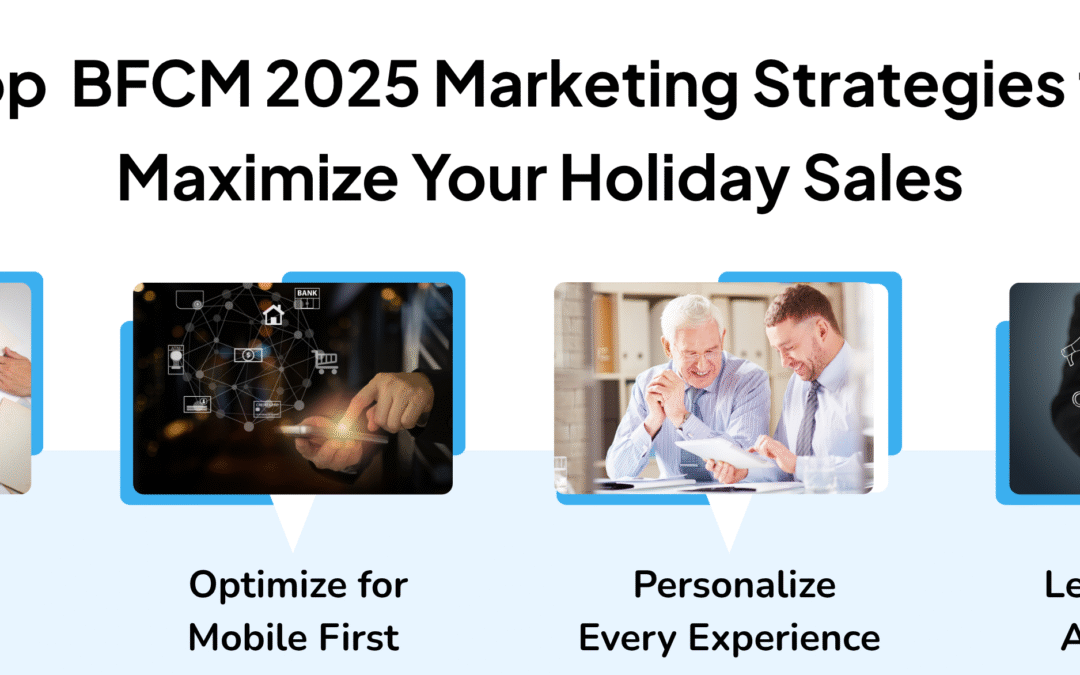
These 7 BFCM 2025 marketing strategies provide the roadmap to drive engagement:
1. Plan Early and Build Anticipation
Waiting until the weekend to launch campaigns is a mistake! Start teasing deals, sending email previews, and running social countdowns weeks in advance. Early engagement builds excitement and ensures your brand is top-of-mind when shoppers are ready to buy.
2. Optimize for Mobile First
Mobile isn’t just a channel—it’s the battlefield. Shoppers scroll, compare, and purchase on smartphones faster than ever. Make sure your site loads quickly, your checkout is smooth, and your mobile UX is flawless. Small friction can cost huge conversions.
3. Personalize Every Experience
One-size-fits-all campaigns no longer cut it. Use first-party data to create personalized recommendations, tailored bundles, and messages that speak directly to each customer’s needs. Personalized campaigns not only grab attention but also increase engagement and conversions.
4. Leverage Paid Advertising Strategically
BFCM is competitive. Invest in paid search, social ads, and retargeting early to warm your audience. Adjust budgets for high-converting days, use eye-catching creatives, and test different messaging to see what drives clicks and conversions.
5. Highlight Social Proof and User-Generated Content
92% of the shoppers trust other shoppers more than brand messages. Showcase reviews, testimonials, influencer shoutouts, and UGC prominently. Authentic proof can nudge undecided buyers toward conversion.
6. Simplify Checkout and Post-Purchase Experience
A smooth checkout, multiple payment options, and clear shipping timelines are essential. Any friction during checkout can lead to abandoned carts. A seamless post-purchase experience builds trust and encourages repeat business.
7. Monitor, Measure, and Adjust in Real Time
Track key metrics like click-through rates, conversions, average order value, and return on ad spend. BFCM is fast-paced and constantly changing. Brands that monitor performance in real time and adjust campaigns on the fly are the ones that maximize results. BFCM 2025 marketing strategies reward brands that are agile and data-driven.
In a nutshell, success in BFCM 2025 marketing strategies come from preparation and smart execution. Even a minor delay can cost valuable sales and attention. Marketers who understand shopper behavior and deliver smooth experiences shine in the pool of cut-throat competition. Plan early, optimize for mobile, create engaging campaigns, and adjust in real time to stay ahead.
With Kleza solutions, you get the tools and support to make it happen. From digital marketing that drives traffic and conversions, to web and mobile app development for user-friendly experiences, we help your campaigns run flawlessly. Combine this with our operational outsourcing and remote IT services, and your team can focus on sales while we handle the rest. Partner with Kleza solutions now and turn BFCM 2025 into your most successful season yet. Reach us at +1 913-800-2728.
