by Navadeep Varma | Sep 3, 2026 | Blog
The business landscape of 2026 is changing rapidly; especially with the use of AI tools that automate traditional workflows. Integrating these tools with existing workflows is no longer an option–it has become a basic necessity for brands to remain competitive. Without human intervention, these AI agents in Digital Marketing can analyze vast datasets, predict user behavior and plan hyper-personalized campaigns in real-time.
On a day-to-day basis, modern enterprises deal with massive volumes of data. Interpreting it requires more time and human intellect- that are simply wasted in performing tasks that can be automated to provide faster results. In order to stay ahead of the competition and keep up with quickly shifting customer demands, businesses must be wiser. They must combine traditional digital marketing strategies and human creativity with intelligence tools to grow sustainably.
Why AI Agents in Digital Marketing Represent a Paradigm Shift
Traditional chatbots or automated algorithms that were used in the past decade did not possess advanced cognitive abilities. On the other hand AI Agents used in Digital Marketing use natural language processing and predictive neural networks to perform several time-consuming tasks. For example, AI agents can optimize multi-channel ad spends, participate in complex email workflows, and create effective landing pages- all by interpreting consumer behavioral patterns. This allows your marketing teams to focus on more strategic tasks. As more enterprises continue to deploy these AI agents in Digital Marketing, a paradigm shift has been observed in the digital marketing industry.
Utilization of AI Agents in Digital Marketing has been shown to reduce customer acquisition costs by up to 30%, while also improving client retention. Recent industry insights have also revealed that organizations that have fully adopted autonomous agent workflows report an impressive 45% increase in conversion rates. These figures indicate that AI agents have a unique ability to deliver the right message to the right audience at the peak moment of user intent. As these systems constantly A/B test themselves by learning through every customer interaction, their process becomes only better with time, without requiring manual development changes.
Key Use Cases of Autonomous Agents in Modern Campaigns
To better understand the use of these systems in real-world environments, we first need to closely look at their practical applications across different touchpoints. Major brands are using these agents in the following ways:
- Hyper-Personalized Content Generation: Real-time creation of highly customized copy, dynamic images, and curated offers tailored for individual users as they browse, utilizing historical preferences.
- Predictive Lead Scoring and Sorting: Agents analyze historical CRM data and real-time clickstream behavior to instantly flag high-value prospects for immediate sales outreach before interest cools down.
- Autonomous Ad Bid Management: Programmatic bidding engines that adjust search, social, and programmatic budgets millisecond-by-millisecond to maximize conversion efficiency and reduce waste.
- Omnichannel Customer Nurturing: Delivering unified conversational experiences across web portals, email pipelines, and social messaging channels without losing the context of the customer's previous queries.
- Self-Optimizing Funnels: Digital agents that observe drop-off points in sales funnels and immediately test layout modifications to maximize user progression.
In 2026, website development, software engineering, and promotional strategy aren't separate disciplines — they're one system. This shift requires a comprehensive digital infrastructure to support these advanced AI tools. When companies integrate these modern web technologies with a robust website development strategy, every point of their digital ecosystem is optimized for high-speed conversion, security and long-term technical reliability.
Implementing AI-Driven Workflows in Your Business
Undoubtedly, leveraging these AI tools to scale their digital presence is a good start for businesses. By implementing these AI Agents in Digital Marketing, they can bridge the gap between raw data collection and immediate actionable user engagement and create dynamic websites that enhance individual customer experiences. Relying on slow monthly performance reviews is a thing of the past- now companies can witness hourly strategic adjustments that are automatically deployed by these software agents. The result? Not static websites but active marketing engines.
As organizations intent on restructuring their organizations for this new era, it's essential to consult an agency that is specialized in deploying these complex AI Agents in Digital Marketing. When you work with experienced technical partners like Kleza, our team ensures that your enterprise’s autonomous workflows are clean, secure and in line with your overall business objectives and compliance standards. You can also check out our blogs highlighting our expertise in the latest technical innovations that have shaped the digital marketing industry over the past decade.
Are you ready to scale your business with the power of AI Agents in Digital Marketing? Contact us at Kleza today to schedule a consultation with our technology experts, and let’s build a future-proof digital strategy together.

by Navadeep Varma | Aug 13, 2026 | Blog
For any business to outgrow the competition, it’s essential to equip itself with the right technology stack. If you’re exploring modern scaling strategies, it’s critical for you to first establish a clear difference between AI Agents and AI Automations. That’s because users are commonly confused between the two, resulting in misallocated resources. By analyzing the key features of AI Agents vs AI Automation, businesses can make better decisions to optimize their operations, streamline workflows and generate higher ROI.
Companies who are unfamiliar with the capabilities of these AI tools often end up deploying tools that don’t align with their business objectives. This is why, instead of blindly following business trends, it’s important for organizations to first identify their precise operational bottlenecks and then decide which tool can help them streamline their processes. Let us first identify the essential differences between AI Agents and AI Automation tools.
Understanding AI Agents vs AI Automation
To figure out how these technologies can be beneficial for you, you must first understand how they process information. Using pre-programmed rules and software, AI Automation tools are excellent for performing repetitive tasks without human assistance. These tools typically operate on the basis of set rules and generate relatively predictable outputs. On the other hand, AI agents are independent entities that are capable of perceiving their environment, applying reasoning skills and making independent decisions to achieve specific goals. So, when you compare AI Agents vs AI Automation; you’re essentially comparing their execution capabilities, flexibility and adaptability,
AI-powered systems can improve operational efficiency by handling repetitive tasks, processing information quickly, and supporting faster decision-making. At Kleza, we help enterprises evaluate the current state of their digital workflows and understand processes that can be automated or enhanced by intelligent AI tools or automations.
Key Differences and Business Use Cases
To understand the different business use cases of AI tools vs AI automations, it is a must to analyze the practical scenarios. AI Automation is useful for structured processes such as automated invoice processing, standardized data entry and synchronized calendar scheduling. On the contrary, AI agents are ideal for use in dynamic environments that require the ability to think- such as customer support routing, real-time market analysis and predictive inventory management.
To better understand the difference between AI Agents and AI Automation, let’s look at how they perform across core business functions:
- Decision Making: AI Automation follows strict "if-this-then-that" rules, while AI Agents analyze context to make autonomous choices in real time.
- Learning Capability: AI Automation generally follows predefined rules until the workflow is updated, while AI agents can use models, context, tools, memory, and feedback to adapt their actions to changing situations.
- Scope of Action: AI Automation is restricted to single, isolated workflows, while AI agents can perform complex, multi-step processes across varied platforms.
- User Interaction: AI Automation typically runs invisibly in the backend, whereas agents can engage in natural, conversational interactions with human users.
Implementing the right approach requires a deep understanding of your technical architecture. Integrating these systems often goes hand-in-hand with custom software solutions, such as professional website development, to ensure seamless data flow across all touchpoints and external integrations.
Which Technology Does Your Business Need?
When analyzing the trade-offs of AI Agents vs AI Automation, businesses must evaluate their tolerance for operational risk, budgetary constraints, and their long-term scalability targets. Deploying intelligent agents may provide a better return on investment when the workflow requires complex decision-making and adaptability. However, if your primary goal is to eliminate manual errors in highly repetitive tasks, then investing in traditional automated systems is your best bet.
However, if your business faces unpredictable data inputs and requires cognitive decision-making, deploying intelligent agents will yield a far better return on investment. Our latest insights on the Kleza blog emphasize that a hybrid approach often delivers the best results. By layering intelligent agents on top of existing automated pipelines, businesses can achieve unparalleled scale. When planning your budget, analyzingAI Agents vs AI Automation ensures you do not overspend on complex cognitive systems when simple, robust automation would suffice.
Furthermore, digital growth requires visibility. Combining these backend technologies with data-driven digital marketing strategies ensures that your optimized operations translate directly into customer acquisition and market authority. Understanding AI Agents vs AI Automation allows your marketing and operations teams to align their performance metrics and scale predictably.
Scale Your Business with Kleza
Are you ready to scale your business operations but still unsure of which tools can help you? Use our expertise to navigate the features and challenges of AI Agents vs AI Automations. Our dedicated team has a practical exposure to the latest trends in AI, and how it has impacted areas like digital marketing, operational outsourcing, and website and mobile app development. They have studied these changes in-depth and adapted to AI tools for more efficient processes and quicker results.They can be a reliable guide to help your business utilize the most relevant AI tools and technologies to outgrow the competition. Contact us today for a personalized consultation to understand the ideal technology stack for your scope of business.

by Navadeep Varma | Jul 29, 2026 | Blog
Did you ever go on a website with a query and an AI chatbot answered your question instantly? Or you may have noticed how you get ads about the exact products that you were searching for. These smart experiences are possible in today’s time due to AI.
AI APIs (Application programming interfaces) are always working behind the scenes! They help businesses add AI features to their existing softwares without creating an AI system from scratch. Businesses are now following AI API integration to reduce time, manual labor, and create better experiences. In this blog, we will explore how AI integration works and how your business can use it to drive growth!
Core Benefits of AI API Integration for Businesses
AI API integration can help businesses improve their existing systems. Instead of spending hours on repetitive tasks, you can now use AI to automate processes and focus on growing your business.
Some key benefits of AI API integration are:
• Saves time and reduces manual work
�Many business tasks take up valuable time every day. AI APIs can take care of these repetitive activities like scanning invoices, and generating reports. This allows employees to focus on tasks that need more attention.
• Creates better customer experiences
Customers want quick answers to their queries. By adding AI features like chatbots and personalized recommendations, businesses can provide faster support and make every interaction more useful.
• Helps businesses make better decisions
�Every business has a large amount of data, but understanding it can be very challenging. AI APIs can help businesses spot important trends, and give businesses insights that support better decisions.
Note: Businesses using AI automation can reduce compliance costs by 30% and complete processes 50% faster. This shows how AI can help companies save time and make daily operations easier.
Practical Uses of AI API Integration for Your Business
AI API integration is flexible. This means that you can use it in different ways for your business. Some companies use it to boost customer service, while others use it for marketing or to add new features to their products. The right use depends on the challenges you want to solve.
Create better marketing campaigns
The success of any marketing campaign depends on how well you understand your audience. AI APIs can help you study buying behavior and discover what type of content gets the best response. You can then use these insights to create campaigns that are more relevant to your customers.
Improve sales processes
Managing leads becomes harder when your sales team has many customers to follow up with. Important details can get missed between emails, calls, and messages. AI APIs can help bring this information together so your team can quickly understand customer needs, check previous conversations, and prepare better before reaching out.
Support employee tasks
AI is not only useful for customer-facing activities. You can also bring AI into your internal tools to support your employees. It can help with tasks like preparing email drafts, creating meeting summaries, finding company information, and handling routine work that takes up employees’ time.
Detect unusual activity
For companies that handle payments or sensitive data and use remote IT services, finding risks early is important. AI APIs can review patterns in transactions and user activity to identify anything unusual. This can help you notice possible issues faster and take action before they become bigger problems.
Add AI features to your products
You do not need to build an AI tool from the beginning to add smart features to your product. With AI APIs you can add features like smart search, voice assistance, and recommendations to your website or app. This can make it easier for customers to use your product.
Take Your Business to the Next Level with Kleza
You may already know that AI can help businesses save time and improve the way they work. But adding AI to your business is not as simple as just choosing a tool and using it. You need to connect it properly with your existing systems and make sure it solves the right problems.
This is where Kleza can help. We help businesses integrate AI APIs into their existing software and use AI features where they are actually needed. Along with this, our team also helps businesses create powerful websites, mobile applications, e-commerce platforms, and digital marketing strategies to improve their online presence and growth.
Want to make your operations smarter and more efficient? Get in touch with our team today to explore how AI API integration can support your business growth. Our experts can help you integrate AI into your existing systems and create solutions that improve productivity and customer experiences.
by Navadeep Varma | Jul 20, 2026 | Blog
Your audience is already telling you what they want to see — you just need to know where to look. Social media can feel like an everyday game of “what should we post today” and Google search console (GSC) gives you clues on how to win that game. It helps you figure out the data of what your audience is searching for. Basically, Google search console is the demand for what you need to supply.
The insights provided by Google search console’s new social media integration can be really useful for creating social media posts. You can turn popular search queries into engaging posts that the audience actually cares about. In this blog, we have included practical tips for google search console social media integration. Read it to discover how to create content that speaks to your audience and delivers value.
What is Google Search Console Social Media Integration?
GSC was traditionally used by businesses to track the performance of their websites on Google search. It was also used to find what people search about to monitor rankings and fix SEO issues. However, social media performance was tracked separately through platforms like Instagram Insights, YouTube Analytics, and other tools.
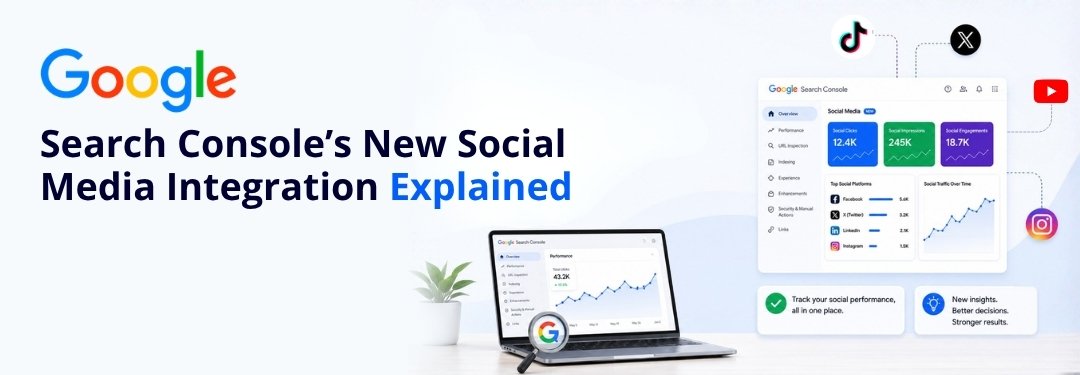
Google Search Console has now expanded its capabilities with a new type of property called platform property. This allows creators and brands to add supported social media platforms, such as Instagram, TikTok, X, and YouTube, to understand how their content appears across Google Search and Discover.
This update brings search and social insights closer together. It helps creators connect the dots between social content visibility and search behavior. You can find more details in Google’s official announcement.
What Can You See with the New Platform Property?
When you connect a supported social media account to Google Search Console, you can access three reports that show how your content appears in Google Search and Discover.
1. Performance Overview
This report shows metrics such as clicks and impressions for your social content. You can also explore the search queries that led people to your posts and identify which content attracts the most visibility.
2. Insights Report
This section highlights recent performance trends and your top-performing posts. It also gives you a better understanding of how people are discovering your social media profiles through Google.
3. Achievements
Google also tracks important achievements. This includes reaching new click milestones over the last 28 days. It gives you a simple way to monitor your overall growth.
Bringing all of this information into one place makes it easier to understand how search and social media work together to increase your online visibility.
The Bigger Picture: SEO, Social Media, and AEO
Remember when SEO was all about getting your website to rank? Those times have changed. Today, people find brands through blog posts, Instagram reels, YouTube videos, TikToks, and even social media posts that appear in Google Search and Discover. This update shows that search and social media are no longer separate. Both can play a role in how people find your brand online.
It also matters for AEO (Answer Engine Optimization). AI-powered search tools are changing how people find information. Instead of only checking websites, they look at different types of content to find answers. Your website, videos, and social posts are like different pieces of the same puzzle that help AI understand your brand better. Google Search Console gives you insights into how these pieces perform together.
Practical Tips for Leveraging the Integration
Search and social media data can tell you a lot about what people are interested in. But numbers alone do not give you the complete picture. You need to look at the reason behind those numbers. Why did a certain topic get attention? Why did people click on one post but ignore another? These small details can help you create better content.
It is easy to see at the viral post of your competitor and think, “Maybe we should create something similar.” But every brand has a different audience. What works for one business may not always work for another. Look at the topics your audience is searching for and the questions they are asking. These are the things that can give you real ideas for your next piece of content.
- Understand Why Some Posts Perform Better
Sometimes a post gets more attention than expected, but you may not know why. Look closely at search behavior along with social performance to identify what made that content successful. Was it the topic? The timing? The problem it solved? These answers can help you boost the quality of your content in the future.
- Turn One Idea into Multiple Content Pieces
A single search query can give you ideas for different types of content. For example, if people there are numerous searches for “how to improve sleep quality,” you don’t have to create only one post around it. You can turn the same topic into an Instagram carousel, a short AI video, blog, or even an email with helpful advice. One topic can give you multiple content ideas and help you reach your audience on different platforms.
- Track the Impact of Social Media
The impact of a post doesn’t always depend on the likes it gets. Sometimes people remember a post and search for the brand later. The same thing happens with your audience. A post can quietly bring more brand searches even if the engagement looks average. That's why it’s important to check what happens after people see your content, not just how they react to it.
- Adjust Your Strategy on a Regular Basis
You cannot expect the same content to work every single time. Trends change, people’s questions change, and their interests change too. By keeping an eye on your search and social media data, you can understand what is getting attention and make changes to your content plan when needed.
In a Nutshell
Using Google Search Console and social media data together can help businesses understand what their audience is interested in. But having access to data is only the first step. The real challenge is knowing what to look for and how to use those insights while planning your content and marketing efforts.
To make your brand stand out online, you need the right strategies and insights. At Kleza Solutions, our team helps you create data-driven strategies based on what your audience is looking for. From digital marketing and website development to remote IT services, we provide solutions to support your online growth. Get in touch with us to learn how we can help your business move closer to its goals.
by Navadeep Varma | Jul 1, 2026 | Blog
Reviews are the building blocks of online marketing. Do you remember scrolling through reviews before buying a new product or even filtering products based on ratings? In today’s digital world, managing these public opinions could be more important for your business than you think. In fact, 97% of the customers say that reviews affect their purchasing decision.
Even a few negative reviews can harm your business faster than the good reviews can build it. They can bring down your rankings, trust factor, and overall SEO. This is why negative feedback needs to be addressed quickly in a proper way. In this blog, we have covered some insightful tips to manage online reputation management after receiving negative reviews. Reviews are not really the issue, but they backfire soon if ignored.
What Negative Reviews Do Behind the Scenes in SEO
Reviews don’t just sit quietly on a page. They start influencing how your business gets seen online. Poor reviews can slowly eat your business by working against search engine visibility. Here’s how they impact:
Decreased Trust and Authority
Search engines like Google always prioritize businesses that are trusted by customers. When your business keeps getting a constant wave of negative reviews, it can signal that users don’t find your business reliable. This can lower domain authority and make it even harder to rank for competitive keywords. Reviews also alter customer behavior. Most people don’t think twice before skipping services or products with low ratings.
Low Click-Through Rates (CTR)
When your business appears online in search results, the star ratings are often shown with it immediately. A low start rating can repel users from clicking on your website even if your business appears at a high position in search engines. Lower CTA makes your listing less relevant to customers and also leads to a drop in ranking.
Reduced Local SEO Performance
Local search engine optimization is really important for businesses that have physical stores. When people look at your website on platforms like Google My Business or Yelp they can see what customers think of you right away. Poor reviews on such platforms can hurt local rankings and drop a business below competitors who have better ratings. This means that fewer people even know that your business exists locally which automatically means less or no customers.
Proactive Online Reputation Management Strategies for 2026
To build a strong online presence, a proactive approach is required. It is not something that needs to be fixed only once, it is something that needs regular updates through consistent actions.
Some of the key strategies to ace online reputation management are:
- Strengthen presence on key platforms
Your reputation is shaped wherever your brand appears. Make sure your profiles on Google, social media, and review platforms are complete and regularly updated. Incomplete or outdated profiles create doubt, even if your service is good.
Let’s look at Domino's Pizza. The brand built a strong digital ecosystem where ordering, tracking, and store information are consistent across all channels. This reduced confusion and made the customer experience smoother, which strengthened trust over time.
- Improve Brand Trust through Content
Reviews help shape how people see a brand. But, they are not the only thing that matters. Keep your website and online profiles updated with content that is easy to understand. A good real life example is Airbnb in its early years.
After trust issues around safety and bad user experiences, they improved their content and transparency. They added more details to listings and explained how bookings work in a simpler way. This helped people understand the platform better and slowly rebuild trust over time.
The best way to deal with bad reviews is to get a lot of good ones. You can actively encourage satisfied customers to share their experiences on relevant platforms. Follow up after a service or purchase and keep the process simple to leave feedback. A higher volume of positive reviews can reduce the trust factor of negative reviews.
Make the timing work in your favour. Ask for feedback when the experience is still fresh so customers respond naturally. You can also use gentle reminders through messages or emails without making it feel forced.
- Track and Respond Right Away
Whether you get positive reviews or negative ones, try not to dismiss them. You can use ORMs like Semrush and Talkwalker to track any feedback across your website. Set a clear internal system so that every review gets a timely response with clear ownership.
Also make sure to acknowledge feedback quickly even if the full resolution takes time. This keeps communication active, prevents delays, and helps you manage reputation before small issues grow further.
- Train teams on customer communication
Reputation is not only online. It starts with how customers experience your service at every touchpoint. Train your teams to speak clearly and politely. Ask them to stay calm even in difficult situations. Most negative reviews start with small communication gaps or delays. When your team handles these moments well, many issues stop there itself.
Make communication part of daily practice. Keep it consistent across all staff. This builds trust through real interactions and reduces complaints before they reach review platforms.
- Turn feedback into visible action
Collecting feedback is not enough. You need to act on it and show that changes are happening. When customers see improvements based on their input, they feel heard. This strengthens trust more than any promotional message. It also encourages more honest feedback in the future.
Review patterns regularly and identify repeated concerns. Fix the root issue instead of handling each complaint separately. Over time, this builds a stronger and more reliable brand image.
Ready to Safeguard Your Online Reputation and SEO?
At Kleza Solutions, we understand that your online reputation often shapes how people see your business long before they contact you. A few negative reviews can quietly affect your brand’s reputation and search visibility. This is why we focus on practical support through our wide range of services such as remote IT, website development, digital marketing, and more. These are designed to keep your brand reputation strong.
Our digital marketing experts create strategic plans that help you manage feedback better and strengthen how your brand is perceived across platforms .Don't let bad reviews hurt your business. Take control with the right online reputation management support and make sure your brand stands out for the right reasons. Get in touch today and start shaping your brand’s story the way it should be seen online.
