
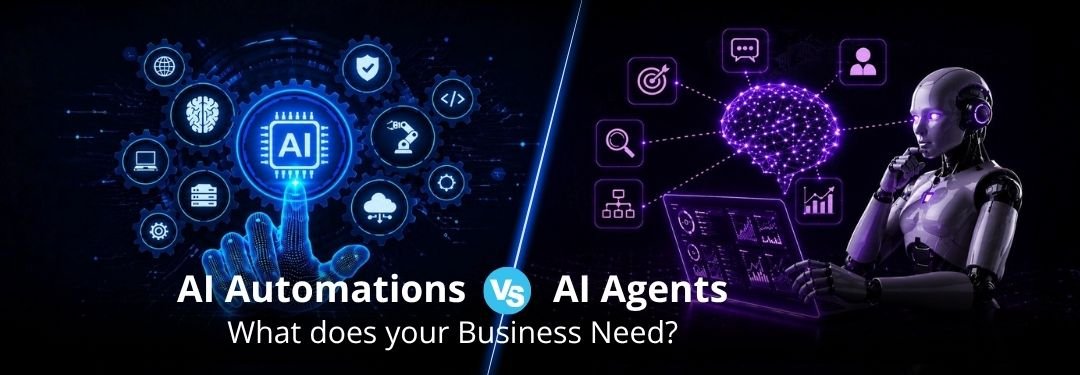
For any business to outgrow the competition, it’s essential to equip itself with the right technology stack. If you’re exploring modern scaling strategies, it’s critical for you to first establish a clear difference between AI Agents and AI Automations. That’s because users are commonly confused between the two, resulting in misallocated resources. By analyzing the key features of AI Agents vs AI Automation, businesses can make better decisions to optimize their operations, streamline workflows and generate higher ROI.
Companies who are unfamiliar with the capabilities of these AI tools often end up deploying tools that don’t align with their business objectives. This is why, instead of blindly following business trends, it’s important for organizations to first identify their precise operational bottlenecks and then decide which tool can help them streamline their processes. Let us first identify the essential differences between AI Agents and AI Automation tools.
Understanding AI Agents vs AI Automation
To figure out how these technologies can be beneficial for you, you must first understand how they process information. Using pre-programmed rules and software, AI Automation tools are excellent for performing repetitive tasks without human assistance. These tools typically operate on the basis of set rules and generate relatively predictable outputs. On the other hand, AI agents are independent entities that are capable of perceiving their environment, applying reasoning skills and making independent decisions to achieve specific goals. So, when you compare AI Agents vs AI Automation; you’re essentially comparing their execution capabilities, flexibility and adaptability,
AI-powered systems can improve operational efficiency by handling repetitive tasks, processing information quickly, and supporting faster decision-making. At Kleza, we help enterprises evaluate the current state of their digital workflows and understand processes that can be automated or enhanced by intelligent AI tools or automations.
Key Differences and Business Use Cases
To understand the different business use cases of AI tools vs AI automations, it is a must to analyze the practical scenarios. AI Automation is useful for structured processes such as automated invoice processing, standardized data entry and synchronized calendar scheduling. On the contrary, AI agents are ideal for use in dynamic environments that require the ability to think- such as customer support routing, real-time market analysis and predictive inventory management.
To better understand the difference between AI Agents and AI Automation, let’s look at how they perform across core business functions:
- Decision Making: AI Automation follows strict "if-this-then-that" rules, while AI Agents analyze context to make autonomous choices in real time.
- Learning Capability: AI Automation generally follows predefined rules until the workflow is updated, while AI agents can use models, context, tools, memory, and feedback to adapt their actions to changing situations.
- Scope of Action: AI Automation is restricted to single, isolated workflows, while AI agents can perform complex, multi-step processes across varied platforms.
- User Interaction: AI Automation typically runs invisibly in the backend, whereas agents can engage in natural, conversational interactions with human users.
Implementing the right approach requires a deep understanding of your technical architecture. Integrating these systems often goes hand-in-hand with custom software solutions, such as professional website development, to ensure seamless data flow across all touchpoints and external integrations.
Which Technology Does Your Business Need?
When analyzing the trade-offs of AI Agents vs AI Automation, businesses must evaluate their tolerance for operational risk, budgetary constraints, and their long-term scalability targets. Deploying intelligent agents may provide a better return on investment when the workflow requires complex decision-making and adaptability. However, if your primary goal is to eliminate manual errors in highly repetitive tasks, then investing in traditional automated systems is your best bet.
However, if your business faces unpredictable data inputs and requires cognitive decision-making, deploying intelligent agents will yield a far better return on investment. Our latest insights on the Kleza blog emphasize that a hybrid approach often delivers the best results. By layering intelligent agents on top of existing automated pipelines, businesses can achieve unparalleled scale. When planning your budget, analyzingAI Agents vs AI Automation ensures you do not overspend on complex cognitive systems when simple, robust automation would suffice.
Furthermore, digital growth requires visibility. Combining these backend technologies with data-driven digital marketing strategies ensures that your optimized operations translate directly into customer acquisition and market authority. Understanding AI Agents vs AI Automation allows your marketing and operations teams to align their performance metrics and scale predictably.
Scale Your Business with Kleza
Are you ready to scale your business operations but still unsure of which tools can help you? Use our expertise to navigate the features and challenges of AI Agents vs AI Automations. Our dedicated team has a practical exposure to the latest trends in AI, and how it has impacted areas like digital marketing, operational outsourcing, and website and mobile app development. They have studied these changes in-depth and adapted to AI tools for more efficient processes and quicker results.They can be a reliable guide to help your business utilize the most relevant AI tools and technologies to outgrow the competition. Contact us today for a personalized consultation to understand the ideal technology stack for your scope of business.