There was a time when online visibility was all about mastering the traditional Search Engine Optimization (SEO). Add the right keywords, polish your meta tags, and watch your site climb through Google’s ranking. But those days are gone. People don’t just “Google it” anymore. They are asking full questions to ChatGPT, talking to Alexa, and expecting instant and conversational answers. Static websites and keyword-stuffed pages just don’t cut it anymore. This is the era of Answer Engine Optimization (AEO) and Generative Engine Optimization (GEO), where being visible means showing up with the right answer, at the right moment, in the right format.
If these acronyms make your head spin, don’t worry. You’re not alone. But understanding what they mean and how they differ can help your business thrive in a world where search is no longer one-size-fits-all. In this blog, we will explain the key differences between SEO, AEO, and GEO along with why your business needs all three to stay visible. Let’s break it down simply!
SEO: Your Website’s Best Friend Since Forever
SEO is like the classic rock of digital marketing—it’s been around forever, and it still gets the job done. It helps your website appear in traditional search engine results when someone types in a question or keyword like “best coffee shop near me” or “affordable graphic designer.
Here’s how it works:
Find the keywords people are searching for.
Write content around those keywords.
Make sure your site loads fast, looks good on mobile, and is easy to navigate.
Build authority with backlinks and consistent content.
SEO brings long-term and sustainable traffic to a website. It helps you appear when potential customers search for products, services, or information. But here’s the thing: the way people search is changing!
From Search to Speak: Why AEO Matters Today
AEO stands for Answer Engine Optimization. It focuses on getting your content picked up by voice search tools like Siri, Alexa, and Google Assistant—or displayed in featured snippets and the “People Also Ask” section on Google. It differs from SEO because instead of optimizing rankings, you are optimizing to provide the best possible answer in the shortest time.
To win at AEO you must:
Use clear, concise language.
Answer questions directly (think FAQs).
Add structured data (schema markup) to help search engines understand your content.
Prioritize helpful, conversational answers.
More people are using voice search to find instant answers—whether they’re cooking, driving, or multitasking. If your business isn’t AEO-optimized, you’re missing those micro-moments.
Writing for AI: The Rise of GEO
Let’s talk about GEO, short for Generative Engine Optimization. It’s all about making sure your content is picked up by AI tools like ChatGPT, Google Gemini, and Bing Copilot when they generate answers. It’s not about ranking or snippets. It’s about making your content useful to AI models that generate answers from multiple sources.
To make it work:
Write in a natural and conversational tone.
Structure your content clearly with headings and lists.
Provide context and depth, not just surface-level info.
Think about how an AI would interpret your content, not just human.
With more users turning to AI assistants for information and recommendations, your content must be AI-friendly to remain visible and relevant.
SEO, AEO, and GEO: What’s the Real Difference?
While SEO once covered most of what we knew about online visibility, the digital world has grown far beyond it. Understanding the distinct roles of SEO, AEO, and GEO helps you cover every touchpoint where your audience is searching—whether by typing, talking, or chatting with AI.
Let’s take a closer look at SEO, AEO, and GEO:
Approach
What it optimizes for
Where it shows up
User behavior
SEO (Search Engine Optimization)
Ranking high in traditional search engine results for relevant keywords and search intent
Google Search, Bing, Yahoo
Typing search queries (e.g., “best pizza in NYC”)
AEO (Answer Engine Optimization)
Providing concise and relevant answers to specific questions
Google featured snippets, People Also Ask boxes, voice assistants like Siri and Alexa
Asking natural-language questions out loud or via mobile (e.g., “What’s the best time to post on Instagram?”)
GEO (Generative Engine Optimization)
Ensuring your content is understood, summarized, and referenced by AI-driven tools
ChatGPT, Google Gemini, Bing Copilot, Perplexity
Conversational or exploratory queries typed or spoken into AI chat tools (e.g., “How do I start a podcast on a budget?”)
Mastering SEO, AEO, and GEO means your brand isn’t just visible—it’s discoverable, relevant, and trusted everywhere your audience is looking.
The Real Risk of Overlooking SEO, AEO, and GEO in Your Strategy
You wouldn’t build a house with only one wall—so why build your online strategy on just one approach? Relying on just one of the three SEO, AEO, and GEO is like trying to win a relay race with only one runner. Today’s visibility requires a holistic approach that ensures you’re present and helpful wherever your customers are—on the Search Engine Results Pages (SERPs), in snippets, and inside generative AI tools.
Let’s break down what happens if you rely on only one (SEO, AEO, and GEO):
If you only focus on SEO:
You may rank in traditional search engines but miss out on being featured in voice search or AI-generated results.
You risk becoming invisible as users shift toward asking conversational questions rather than typing keywords.
If you only focus on AEO:
You might appear in featured snippets or get read out loud by Alexa—but without ranking on search engine result pages (SERPs), you lose broader visibility and long-term traffic.
Your content could be overly short and not offer enough depth for users wanting more than quick answers.
If you only focus on GEO:
You could become a go-to source for AI assistants but be totally absent from Google or Bing, where billions of searches still happen every day.
Without optimizing your site technically, AI may find your content—but real people won’t.
How to Build a Strategy That Covers SEO, AEO, and GEO?
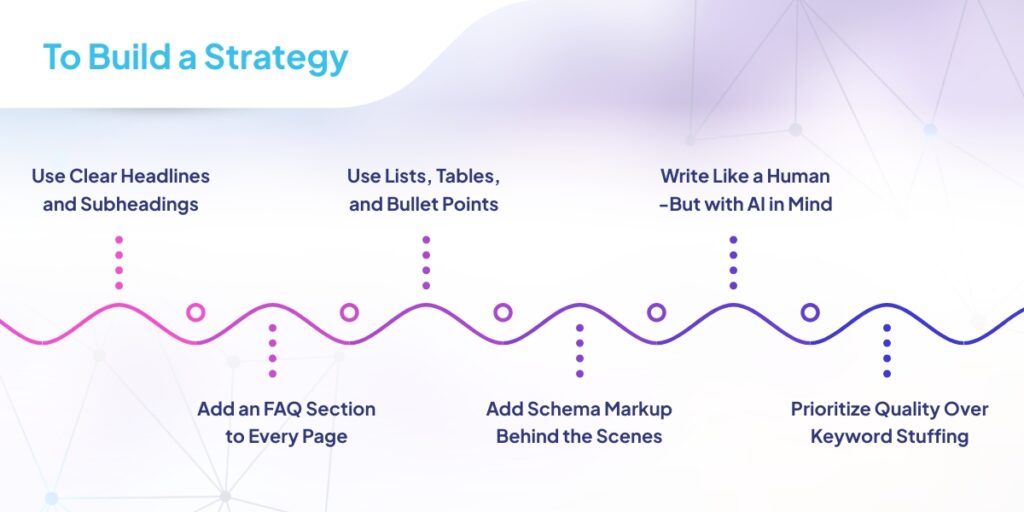
While all of this may seem like a lot to process, the good news is that you don’t need three separate content strategies to win with SEO, AEO, and GEO. You just need one smart, flexible approach that speaks to people and machines. Here’s how to do it:
1. Use Clear Headlines and Subheadings
Your titles shouldn’t just be catchy—they should also be useful.
For SEO: Headings signal structure and relevance to search engines.
For AEO: Clear subheadings make it easy for Google to lift your answer into a featured snippet.
For GEO: AI tools like ChatGPT use headings to understand what each section is about and respond with context.
Think of your headings as signposts—guiding both humans and algorithms to the good stuff.
2. Add an FAQ Section to Every Page
FAQs are gold for discoverability across all platforms.
SEO loves the long-tail keywords embedded in question form.
AEO uses these questions to pull quick answers for voice and snippet results.
GEO picks them up as bite-sized, helpful nuggets to include in AI-generated responses.
Pro tip: Use real questions your customers ask. They’re more natural, and more likely to be searched.
3. Use Lists, Tables, and Bullet Points
Formatting matters—a lot.
Bullets and tables make it easier for Google to extract structured answers.
They allow voice assistants to read answers in a clean, logical way.
AI tools can scan and repackage this info into summaries or responses.
Short and scannable content performs better—no matter where it’s read.
4. Add Schema Markup Behind the Scenes
It’s not visible to users, but schema is a behind-the-scenes powerhouse.
It tells search engines exactly what your content is—whether it’s an article, event, review, or product.
That helps improve visibility in rich snippets and voice search results.
It also boosts credibility with AI models that rely on structured data to summarize your content.
A little code goes a long way toward making your content “machine friendly.”
5. Write Like a Human—But with AI in Mind
You’re not writing an essay for a robot. But you are writing for tools that read like humans do.
GEO thrives on natural, conversational language.
SEO and AEO still rely on clarity, structure, and directness.
Think: “How would I explain this to a curious friend?” That’s usually a sweet spot.
6. Prioritize Quality Over Keyword Stuffing
You don’t need to cram “best SEO tips” into every sentence.
Today’s search engines—and AI tools—are smarter than that.
They reward content that’s original, helpful, and relevant.
Overused keywords can actually hurt your ranking and trustworthiness.
Create content that educates, informs, or solves a problem. That’s what ranks, gets shared, and gets surfaced in AI answers.
To Wrap it Up!
Search isn’t what it used to be. It’s no longer limited to just typing a question into Google and scrolling through a list of results. Whether someone is typing on Google, asking a voice assistant, or chatting with an AI tool, the way people search has evolved—and your strategy should too. That’s where SEO, AEO, and GEO each play a critical role.
At Kleza Solutions, we understand that staying visible means being present everywhere your audience is searching—whether it’s through a search engine, a voice command, or an AI chat. We help you build a strategy that ticks all the boxes with structured content, real answers, and optimized messaging for every platform. So instead of just chasing rankings, focus on being relevant, clear, and truly helpful—because that’s what your audience is looking for now. If you plan to build an approach that combines SEO, AEO, and GEO, reach us today at +1 913-800-2728 and our experts will guide you.
Adapt to survive- this is the reality of today’s digital marketing world. Every few weeks, we get to see new digital marketing trends that rewrite the algorithm, causing your digital content to either engage or topple consumer attention within minutes. So, are you playing by the rule book or stuck in limbo, unable to take your brand ahead? For marketers and leaders, clinging to yesterday’s playbook isn’t just risky—it’s corporate self-sabotage. It is high time that as a successful digital marketer in 2025, you rethink your planned strategies and ask yourself– will these be able to captivate, convert, and command loyalty in an era where audiences don’t just scroll—they demand magic?
In this blog, let’s dive deep into the top 10 digital marketing trends that are set to shape 2025. They’re not just here to stay but they’ll also define the next decade of the industry. Arm yourself with these useful insights that can help reshape your digital marketing strategy and stay ahead of your competition.
Consumer-Centric Digital Marketing Trends that Drive Impact
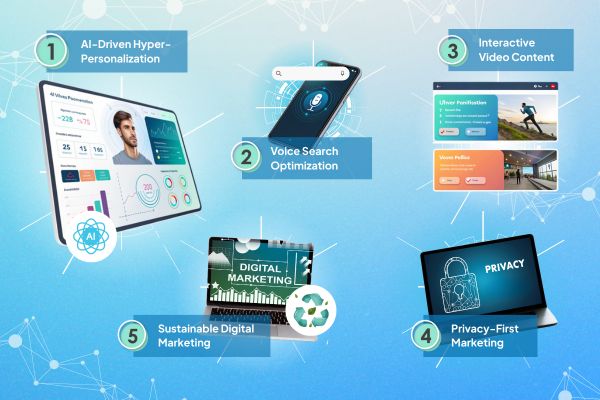
AI-Driven Hyper-Personalization
Artificial Intelligence is no longer a buzzword; it’s the backbone of modern digital marketing trends. This year, AI will power hyper-personalized experiences that go far beyond addressing customers by name. Think real-time product recommendations, dynamic pricing based on browsing history, and content tailored to individual preferences—all delivered at the right moment.
Why It Matters:
80% of consumers are more likely to buy from brands offering personalized experiences.
AI reduces guesswork, enabling precision targeting that boosts ROI.
Actionable Tips:
Invest in AI tools like Google’s Analytics AI or Adobe Sensei to analyze customer data.
Use dynamic content blocks in emails and landing pages.
Segment audiences based on behavior, not just demographics.
Voice Search Optimization
With over 1 in 5 US adults owning a smart speaker optimizing for voice search is non-negotiable. Brands looking for new digital marketing trends can adopt conversational AI chatbots that respond to voice queries which are longer and often local (e.g., “Where’s the nearest vegan café open now?”).
Brands that ignore voice search risk losing visibility in a hands-free, voice-first world.
Actionable Tips:
Target long-tail keywords and natural language phrases.
Optimize for local SEO with Google My Business updates.
Create FAQ pages that answer specific, voice-driven questions.
Interactive Video Content
Forget static videos—2025 is all about interactive content where viewers influence the narrative. Both B2B and B2C marketers can use interactive short-form video content as part of their strategy; such as choose-your-own-adventure ads, shoppable videos, and live polls during streams. These digital marketing trends are surely here to stay!
Why It Matters:
Interactive videos achieve more engagement than static videos.
They bridge the gap between entertainment and conversion.
Actionable Tips:
Use platforms like YouTube Interactive or Vimeo OTT for branching scenarios.
Embed shoppable tags in product demos.
Host live Q&A sessions with clickable CTAs.
Privacy-First Digital Marketing Trends
With third-party cookies phased out and regulations like GDPR tightening, marketers must pivot to privacy-first strategies. Consumers demand transparency, and brands that respect data privacy will win trust. This digital marketing trend is a must to adopt as it helps you boost your relationship with the consumer, by fostering security and trust.
Why It Matters:
75% of consumers feel that tech companies have too much control over their data.
80% of consumers believe that brand purchase history is the most acceptable data to collect.
Actionable Tips:
Build email lists with gated, high-value content (e.g., webinars, eBooks).
Use contextual advertising instead of behavioral tracking.
Implement clear consent forms and data usage policies.
Sustainable Digital Marketing Trends
Eco-conscious consumers are scrutinizing brands’ environmental impact—including digital footprints. Sustainable digital marketing trends focus on reducing carbon emissions (e.g., energy-efficient websites) and promoting ethical practices.
Why It Matters:
66% of consumers consider sustainability when making purchases.
Green brands enjoy higher loyalty and advocacy.
Actionable Tips:
Optimize media files to reduce page load emissions and boost website ranking.
Highlight sustainability efforts in environmental campaigns conducted.
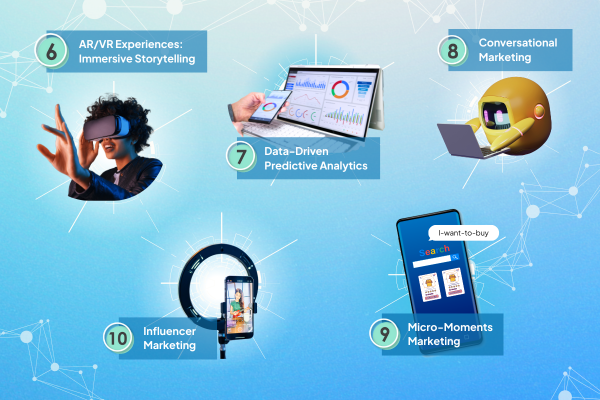
AR/VR Experiences: Immersive Storytelling
Augmented Reality (AR) and Virtual Reality (VR) are digital marketing trends that are transforming how consumers interact with brands. To understand this concept better, imagine having the ability to access virtual try-ons for makeup, AR-guided product demos, or VR real estate tours—all from a smartphone.
Why It Matters:
71% of consumers prefer AR experiences when shopping.
Immersive tech reduces return rates and boosts confidence.
Actionable Tips:
As part of digital advertising, launch Instagram or Snapchat AR filters for product trials.
Create VR showrooms for high-value items (e.g., cars, furniture).
Predictive analytics uses historical data and machine learning to forecast digital marketing trends, customer behavior, and social media marketing campaign outcomes. This basically means you’re not just shooting arrows in the darkness, rather your brand is analyzing consumer insights and behavior to design marketing campaigns that can drive conversions.
Why It Matters:
Companies using predictive analytics see better lead generation.
Anticipate churn, demand spikes, and content trends.
Actionable Tips:
Deploy tools like Google Analytics 4 to score your social media strategy.
We can already sense the power of advanced AI chatbots and digital messaging apps while using several websites on a day-to-day basis. To join the digital marketing trend, an increasing number of brands have adopted the language of these bots and integrated it with Google PPC ads to generate sales. These bots resolve queries instantly, book appointments, and even upsell—all while mimicking human empathy.
Micro-moments—when consumers turn to devices for quick answers—are critical. Think “I-want-to-know,” “I-want-to-go,” or “I-want-to-buy” moments. Winning these seconds requires a smart content marketing approach. If you wish to join this digital marketing trend, you need to learn to recognize the micro-moments that are critical to consumer decision-making and then deploy a befitting approach.
Why It Matters:
96% of people use smartphones to accomplish immediate tasks.
Brands that act fast gain lifelong customers.
Actionable Tips:
Optimize for mobile-first, snackable content.
Use Google Ads real-time bidding for intent keywords.
Create “how-to” videos and instant checkout options.
Influencer marketing
An existing digital marketing trend that is evolving this year is that influencer marketing will pivot toward AI-driven micro-communities and virtual creators who resonate with hyper-niche audiences. Audiences will crave unfiltered, relatable User-generated content—whether it’s a TikTok creator reviewing eco-friendly products in real-time or a virtual influencer hosting a VR pop-up concert.
Why It Matters:
Over 70% of Gen Z consumers trust influencers over traditional ads.
Virtual influencers reduce branding costs by 40% while offering 24/7 global reach.
Actionable Tips:
Leverage nano-influencers for niche markets
Experiment with virtual influencers for futuristic campaigns
Co-create AR experiences: Let influencers design Instagram/TikTok filters that showcase your product in action.
Ace your Marketing Strategy, Learn and Embrace Digital Marketing Trends
We’re almost through the first half of 2025, but that doesn’t mean it’s too late to spin around your marketing strategy and lead the second half. The digital marketing trends we’ve explored are not just fleeting buzzwords but game changers that are reshaping how brands engage, innovate, and thrive in an increasingly connected world. Brands now have unprecedented tools to captivate audiences and have their undivided attention. Imagine virtual storefronts where customers try products in 3D. But these innovations are only useful if you know how to leverage them strategically. Plus, it’s significant to remember that at its core, marketing has to remain profoundly human-centric, prioritizing empathy, inclusivity, and authentic storytelling to forge emotional connections in a digital-first era.
Push yourself to think: Is my brand ready to meet audiences where they’ll be—not just physically, but emotionally and digitally engaged? It’s time to experiment, upskill, and future-proof your strategy. Embrace these digital marketing trends not as challenges, but as invitations to innovate, inspire, and lead in a market where change is the only constant. However, we do understand that navigating these changes alone can be a difficult task. That’s where Kleza Solutions comes in.
Don’t just try to keep up- lead the change with a strong vision. It is essential to gain a clear understanding about which of these digital marketing trends is more suited to your brand. For professional support, choose us for mapping your marketing strategy and aligning it with the latest digital marketing trends. Witness how our expertise pens down your brand’s success story. Contact us today to take your brand on a new pathway of excellence.
Have you ever wondered how some businesses attract customers effortlessly? Well, the answer is they strongly focus on their lead generation strategies. In our digital era, almost everyone depends on the internet for a wide range of needs. From shopping for the latest fashion and ordering gourmet food to booking vacations and seeking educational resources, the internet has become our go-to solution for convenience and efficiency.
The traditional methods of finding customers and using physical signs for advertising are becoming outdated. Moreover, in today’s fast-moving digital world, having a strong online presence is crucial for any business to thrive. Running your business without an online strategy or not keeping up with competitors is like playing chess without knowing its rules. Thus, it is essential to implement the right lead generation strategies to boost your business. However, with so many tactics available in the market, choosing the right ones can be a bit overwhelming. Don’t worry – we’ve saved you the hassle and confusion. We’ve carefully selected the top 10 easy-to-understand and effective strategies for generating leads. These strategies will guide you in attracting and engaging a wider customer base more effectively.
What is Lead Generation?
Lead generation is the core of every online business! It is the process of attracting customers to your business and converting them into potential clients or “Leads”. In simple words, the aim of lead generation is to attract a visitor, grab their interest, pull them into the sales funnel, and then convert their interest into a sale. In addition to this, it involves various marketing and advertising strategies to capture the attention of a target audience.
Process of Lead Generation
The process of generating a lead involves several stages. Here’s a general overview of the process.
1. Audience Targeting
Firstly, a visitor discovers your business through one of your marketing channels, such as your website, blogs, or social media platforms.
2. Engagement
Secondly, the visitor or customer becomes interested in your services or products, they click on a Call to Action (CTA) button.
3. Information Gathering
Subsequently, the CTA directs them to a landing page, where they find comprehensive information about the product or service.
4. Conversion
Lastly, if the customer is still interested, they fill out a form to get your services. This causes the successful generation of a lead.
This entire process is only possible if the customer visits your website in the first place. Hence, it’s crucial to use different strategies for attracting leads.
Top 10 Lead Generation Strategies
Lead generation is a crucial aspect of business growth. Therefore, we present some simple and effective strategies to attract customers and retain them
1. Content creation
Content is definitely “The King” when it comes to lead generation. Besides, it is the first thing that users notice about your business. Almost, 76% of online marketers use the power of high-quality content to generate leads. This includes blogs, e-books, newsletters, FAQ’s and much more.
But here’s the secret sauce: Search engines love good content too. Therefore, when your website has useful content, search engines notice that and index your website. Moreover, this drives organic traffic and makes your website appear faster on search engines. Remember to keep these points in mind before creating content:
Understand your audience
Write SEO-friendly content
Use catchy headlines and words
Offer valuable resources
Maintain a consistent brand voice
Leads are captured only when people notice you! Here are some tools to make your content search engine friendly SEMrush, Grammarly, WordStream etc.
2. Website optimization
If you are looking to convert random clicks on your website into potential leads, then web optimization is the answer. In fact, 94% of the website impression is created due to its design. In this fast-paced digital world, a user-friendly website is used as fuel to drive your success. And with the right optimization moves, you’ll not only capture attention but also turn those clicks into loyal customers.
Here are some simple ways to optimize your website –
Responsive Design – Ensure adaptability to different devices and screen sizes.
Page Load Speed – Optimize images and code for faster load times.
Call-to-Action (CTA) – Place clear and strategic CTAs for desired actions.
SEO Best Practices – Implement on-page and off-page SEO strategies.
Social Media Integration – Connect with social platforms for increased visibility.
Regular Updates – Keep content and information current and relevant.
Accessibility – Ensure compliance with web accessibility guidelines.
3. Email Marketing
Email Marketing isn’t about just sending emails; it’s about building a relationship with customers. It is the process of generating leads using email opt-in forms (friendly pop-ups that ask permission of users to receive emails). Generally, email marketing is done in the form of promotions, newsletters, sponsorships etc. According to HubSpot research, the revenue of email marketing is estimated to be 11 billion by the end of 2023.As a result, email marketing also helps with:
Brand Awareness
Building relationships
Educating customers
Promoting discounts etc.
4. Social Media
Social Media is like the Gold Mine for Lead Generation. Platforms like Facebook, Instagram, Twitter etc. help to directly connect and interact with your audience. Did you know that 90% of customers buy products from the brands they follow on social media? That is exactly how powerful social media is if used correctly. Hence, to make the best use of social media for generating revenue , follow this:
Target Your Customers – Understand your audience demographics and resonate with the right people.
Do in-depth data analytics – Utilize robust data analytics tools to gain valuable insights into user behavior.
Post variety of content – Diversify your content with a mix of images, videos and infographic posts.
Showcase customer testimonials – Highlight positive experiences from satisfied customers, to build trust.
Do A/B Testing – Conduct A/B testing to identify what resonates best with your audience.
Note – There is no hard and fast rule when it comes to social media. Therefore, you need to experiment with different tactics to analyze what works best with your customers.
5. Display Ads
Display ads are like online billboards for the digital world. They are magnets for lead generation as they create brand awareness and drive huge traffic to your website.
When you browse websites or use apps, you might see these ads popping up on the side, top, or bottom of the page. These ads are more than just pictures; they can be interactive, showing videos or animations. Advertisers use display ads to grab your attention and tell you about their products or services.
Sometimes, these ads are based on your interests or things you’ve searched for online. Hence, advertisers use this information to show you ads that they think you might be interested in.
Display ads can be found on various websites and social media platforms. So, the next time you see a colorful banner or a moving picture while surfing the web, you’re probably looking at a display ad!
For result-generating display Ads:
Choose websites or platforms that align with your target audience.
Design visually compelling ads with clear and concise messaging.
Include a strong and clear CTA in your display ads.
Ensure your display ads are optimized for various devices and screen sizes.
6. PPC (Pay-Per-Click)
Pay-per-click (PPC) advertising is an effective and targeted strategy for lead generation in digital marketing. PPC allows businesses to place ads on search engines and other platforms. With this strategy, businesses pay a fee only after their ads are clicked. Therefore, if executed thoughtfully, PPC can be a powerful tactic for attracting high-quality leads and driving conversions.
Here are key elements to consider when using PPC for lead generation:
Keyword Research – Identify and target the right keywords in Ads to appear in relevant search results.
Compelling Ad Copy – Highlight unique selling points and use creative language to capture attention.
Landing Page Optimization – Ensure that the landing page your ads direct users to is optimized for conversions.
Budget Management – Set a realistic budget for your PPC campaign and monitor its performance regularly.
7. Offer Deals and Discounts
Providing special deals and discounts is a proven strategy to get new leads and retain existing ones. It’s like having a secret weapon to not only get attention but also to turn clients into happy customers. Discounts usually increase sales as they create a sense of urgency among customers. Moreover, people love to save money and they have a feeling of accomplishment after buying things at a lower price. According to the studies, 92% of customers look for a discount while buying products or services online.
Here are some of the easy ways to implement this strategy and get the most out of it-
Limited-Time Offers – Create a sense of urgency by introducing limited-time offers. This encourages customers to make a purchase sooner rather than later.
Loyalty Programs – Reward loyal customers with exclusive discounts or perks. These loyalty programs retain customers and encourage them to buy from the same place.
Bundle Offers – Offer a discount price when customers buy a certain number of products or services. Bundle offers can increase the average transaction value and provide added value to customers.
Flash Sales – Occasionally introduce flash sales with significant discounts on selected items. Also, promote these sales through various channels to maximize their impact.
8. Creative Video Marketing
Videos play an important role in engaging and captivating customers. In fact, 96% of marketers consider videos as an important part of their marketing strategy. Additionally, videos help to generate more leads when compared to written content like blogs or newsletters.
Video marketing is an amazing strategy as people enjoy watching videos. Through videos, customers don’t just read words — they experience and absorb the content. And that’s what you want when you’re trying to turn viewers into potential customers.
Here are some strategies to leverage creative video marketing for effective lead generation:
Storytelling Through Video – Engage your audience by telling a compelling story through your videos.
Interactive Videos – Incorporate clickable elements, quizzes, or polls within your videos to make the viewing experience more engaging.
Live Streaming – Utilize live streaming to connect with your audience in real-time.
Educational Content – Share tutorials, how-to guides, or informative content related to your products or services.
User-Generated Content – Encourage your customers to create and share videos featuring your products or services.
Short-form Videos for social media – Create catchy, concise videos that quickly convey your message.
SEO-Optimized Videos – Use relevant keywords, create descriptive titles, and add captions to make your videos more discoverable.
9. Webinars and Online Events
Webinars have become a common lead-generation strategy due to the personal touch they offer. However, the key to a successful webinar lies in the hands of your audience.
Imagine you’re telling a story to your friends. If they’re not interested, they might get bored and leave. The same goes for webinars. The people who join should find the topic interesting and useful. Moreover, if the webinar is about cooking and someone joined because they want to learn about painting, they won’t enjoy it.
Therefore, here are some tips to maximize the impact of webinars for lead generation:
Choose relevant and trending topics that align with your audience’s interests.
Promote your webinar through various channels, including social media, email, and your website.
Collect participant information during registration to build your contact list.
Encourage audience interaction through Q&A sessions and polls.
Follow up with attendees by providing additional resources and exclusive offers.
So basically, webinars are like online classes where businesses and experts sell their products, and the success depends on making it interesting for the audience.
10. Chatbots and AI-Powered Interaction
Running a business means you no longer work 9-5; it means you work 24/7. Therefore, if you have an online business, then you can’t expect people to contact you only during working hours. Customers can visit your website anytime during the day, from any place in the world and expect to find immediate response. Additionally, if your website won’t be able to give a response, then leads will immediately move to the competitor’s website. This issue can be easily solved by integrating AI with your online business.
Implementing chatbots on your website or social media platforms can enhance user engagement and capture leads effectively. On the contrary, chatbots provide instant responses to user queries and collect relevant information for lead generation. Hence, key considerations for using chatbots include:
Personalize interactions based on user behaviour and preferences
Use chatbots to qualify leads by asking targeted questions
Integrate chatbots with your CRM system to streamline lead management
Provide options for users to leave their contact information for follow-up
Continuously analyze and optimize chatbot performance based on user interactions
Choose Kleza for Effective Lead Generation
Overall generating leads online is important for a successful business in today’s digital world. The strategies mentioned above are like a guide to help businesses attract and convert potential customers into valuable leads. In addition to this, it’s important to be flexible and regularly update your lead generation strategies based on changing market trends and customer behaviours. Moreover, building and keeping meaningful connections with your audience is an ongoing process that needs dedication, creativity, and a commitment to providing real value.
To skip the hassle of generating leads for your business choose Kleza! We use cutting-edge strategies to captivate the audience and elevate your brand to new heights. Our team of experts analyze your website and improve its visibility for generating potential leads. We go above and beyond by utilizing a variety of lead-generation strategies tailored to your unique business needs. Moreover, from creative content marketing to engaging social media campaigns, we’ve got every angle covered to capture and engage your target audience.